
Departmental Programs
Discover and engage with programs that match your passion!
Bachelor of Laws (LL.B. Honours)
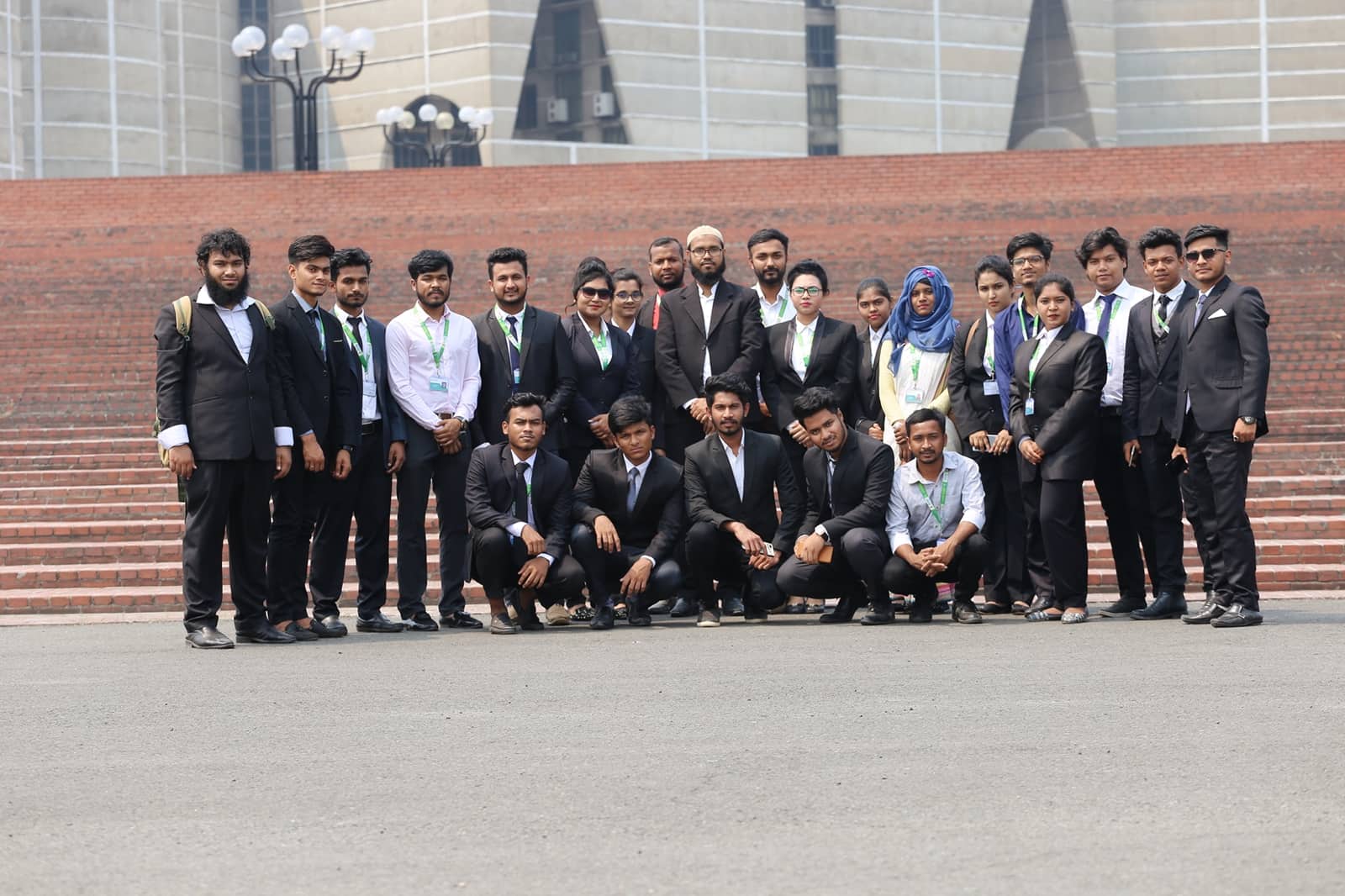
Objectives:
As the law plays an increasingly important role in almost all spheres of modern life, the degree will continue to provide a useful qualification for both personal and professional development. There are also wide opportunities for legally trained graduates in many other institutions i.e. banks, companies, industries, socio-legal governmental and non-governmental organizations, international organizations etc. The specific objectives of the program are as follows:
To ensure carrier oriented legal knowledge- pre-requisite to traditional law-related professions and services
To offer practical curricula to ensure enrollment with different professional bodies including Bar Council
To promote interactive teaching-learning and legal research of international standard
To strengthen the progressive changes in regard to rule of law, sustainable development, gender equality and human rights
To facilitate comparative studies both in legal and socio-economic areas
To enhance opportunities and provide support for scholarly research, writing, and publication by faculty members and students.
To encourage students to contribute to the society and nation
To develop the capacity of the students to analyze and examine the interdisciplinary impacts of domestic laws
To build up inter personal communication skills of the graduates
Program Structure:
The Department of Law offers LL.B. (Hons.) and LLM programs. The duration of the LL.B. (Hons) is four academic years divided into 12 trimesters. The LL.B. (Hons.) program contains 128 credits having 43 courses. To obtain LL.B. (Hons.) degree from GUB a student will have to complete 125 credits with a minimum CGPA of 2.0 in all courses individually. The courses structure for LLB (Honors) are given as under:
S/L | Nature of Courses | No. of Courses | Credit Hours |
1 | GED Non-Credit Courses | 1 Course | 00 Credits |
2 | GED Credit Courses | 3 Courses | 9 Credits |
3 | Theoretical Courses | 35 Courses | 109 Credits |
4 | Practical Courses | 2 Courses | 7 Credits |
5 | Internship Course | 1 Course | 3 Credits |
6 | Professional skill Development Course | 1 Course | 00 Credit |
Total | 43 Courses | 128 Credits | |
Academic Competencies:
The technical/academic competencies require students to gain advanced knowledge, skills and experience in the following areas of law:
Application of substantive and procedural law: Graduates will be able to apply the substantive and procedural law in practical fields i.e. in the courtroom, negotiation, arbitration and judgeship.
Understanding and conducting litigation procedure: The law graduates of GUB will be able to apply the advocacy techniques and conduct litigations in courts.
Drafting legal instruments: Graduates of law will be able to draft different legal drafting and conveyancing for their clients.
Ability in legal analysis and legal reasoning: The Law graduates will have critical thinking and problem-solving skills which will enable them to identify legal issues from facts, apply the law, and draw conclusions.
Updated knowledge with technological integration: The law graduates will keep them update in respect of new legal problems and will be capable to solve adopting up-to-date technology in legal practice
Ethical and professional liability: The graduate is expected to recognize the most common ethical and professional liability dilemmas and resolving them with high professional standards and conduct him or herself in accordance with standards of professional conduct.
Expertise and expert knowledge: The students will be able to utilize expertise and expert knowledge learning from experience through self-critique and learning from experience through self-critique using procedural tools such as motions and discovery.
Application of the principles and policies of law in legal practice: The graduate is expected to apply the principles and policies reflected in the law governing lawyers, including a lawyer’s duty of loyalty to clients, fiduciary duties, and obligation of zealous representation.
Find Us
- Purbachal American City, Kanchan, Rupganj, Narayanganj-1461, Dhaka, Bangladesh
+880-9614-482482, 01324-713502, 01324-713503, 01324-713504, 01324-713505, 01324-713506, 01324-713507, 013247-13508
- addmission@green.edu.bd
Departments
Centers
- Center for Career Development (CCD)
- Center for Language and Cultural Studies (CLCS)
- Center For Research Innovation and Transformation and Sustainability(CRITS)
- Center for International Affairs (GCIA)
- Center of Excellence for Teaching And Learning (CETL)
- Center for Continuing Education (CCE)
- Institutional Quality Assurance Cell(IQAC)
Offices
- Office of the Vice Chancellor
- Office of the Pro Vice Chancellor
- Office of the Treasurer
- Office of the Registrar
- Office of the Exam Controller
- Office of the Admission
- Office of the Accounts
- Office of the GCITS
- Office of the Proctor
- Office of the Library
- Coordination Office
- Office of the Public Relation
- Office of the Student Affairs
- Medical Center
- Office of Logistics
- Others Office
© 2003-2026 Green University of Bangladesh. All Rights Reserved.
Developed by GCITS